11 Ways the MEGA Act in Congress Tries to Control How You Vote
In the final reform roundup of January, I briefly discussed a new bill in the US House that attempts to overhaul elections in every state called the Make Elections Great Again Act (or MEGA Act for short). This bill touches on everything from:

In the final reform roundup of January, I briefly discussed a new bill in the U.S. House that attempts to overhaul elections every state called the Make Elections Great Again Act (or MEGA Act for short). This bill touches on everything from:
- Voter ID
- Proof of citizenship requirements
- Mail-in voting
- Voter roll maintenance
- Post-election audits
- Banning ranked choice voting.
- And more
The knee-jerk response from critics has been the assertion that Republicans are trying to “nationalize” the elections process. President Donald Trump has even used that phrase, raising alarms from his opponents.
Meanwhile, supporters frame the MEGA Act as an “election integrity package.”
The truth, however, is there are plenty of things in the MEGA Act that Congress and Trump can’t do because the U.S. Constitution makes it explicitly clear that control of the “time, place, and manner” of elections resides with the states.
And despite the narrative that Trump wants to cancel elections, there are systemic and legal barriers in place to prevent this from happening – even if it is good fearmongering for opponents to use in fundraising emails.
Just like it is good fundraising fodder for Republicans to suggest undocumented immigrants and dead people are voting in vast numbers.
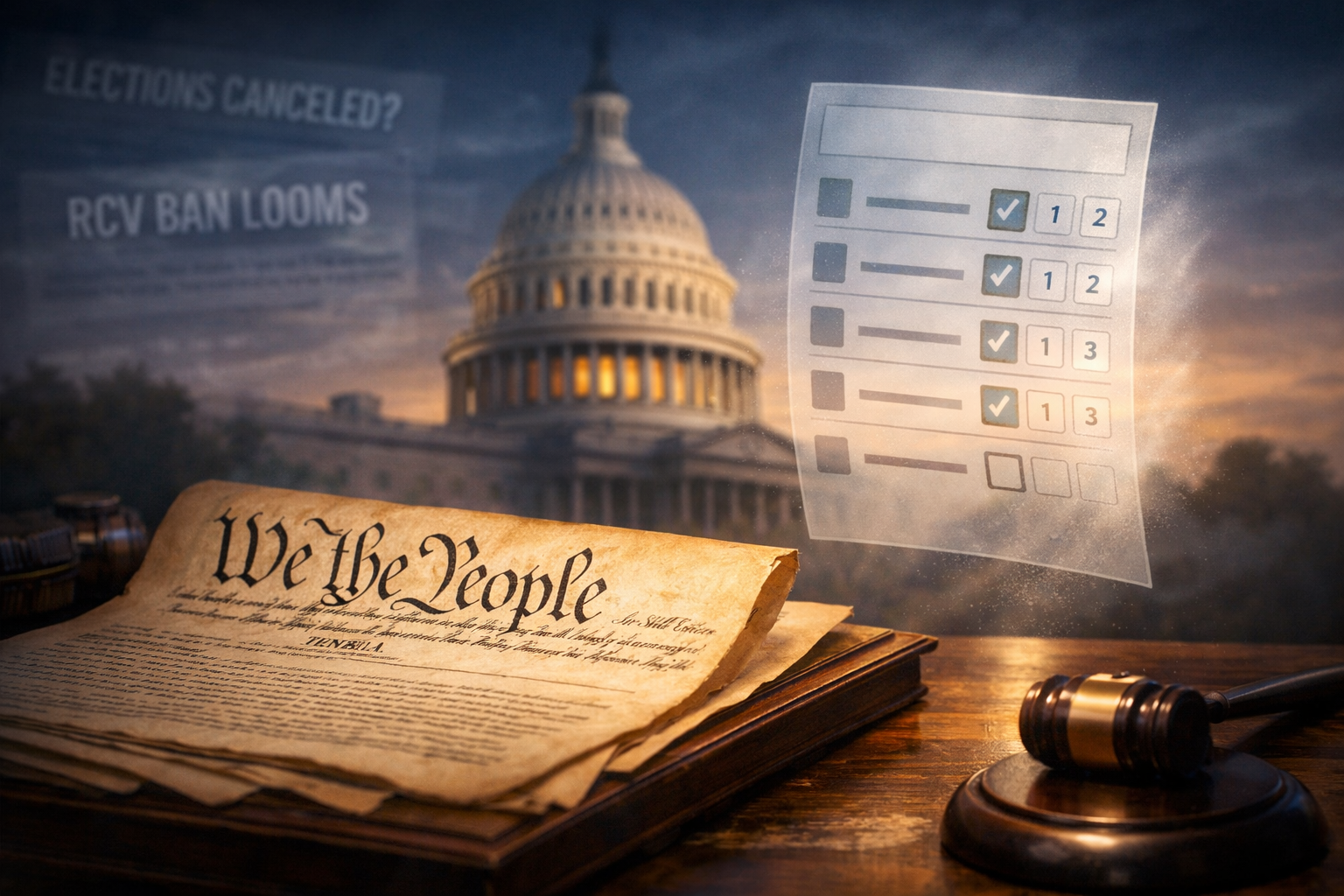
Article I, Section 4 of the U.S. Constitution, which is known as the Elections Clause, states:
The Times, Places and Manner of holding Elections for Senators and Representatives, shall be prescribed in each State by the Legislature thereof; but the Congress may at any time by Law make or alter such Regulations, except as to the Places of [choosing] Senators.”
As noted in the piece, “No, Trump Can’t Cancel Elections or Ban Ranked Choice Voting,” the courts have long interpreted this clause to mean that congressional authority to “make or alter such regulations” is severely limited.
For example, Congress can and has set uniform standards for voter eligibility, protections, and national election dates.
But largely, the states control the manner in which elections are conducted, including what primary systems they use, the use and extent of early voting, rules on mail-in and absentee ballots, what voting methods are allowed or banned, etc.
The MEGA Act touches on most of these things, and while its scope is extraordinary, it is important for people listening to the narratives coming from the Republican and Democratic Parties to take a deep breath and understand what is in the bill,
Many of its components wouldn’t survive a legal challenge, like a ban on universal mail-in voting. While Trump has railed against it, every state has its own mail-in voting rules and some states, like Colorado and Washington, conduct their elections entirely by mail.
To ban universal mail-in voting would require these states to completely change the way they conduct elections, going beyond the scope of what Congress is allowed to alter and regulate when it comes to elections.
To understand what is in the MEGA Act, here is a complete breakdown of all of its proposals.
1. National Photo ID Requirement for Federal Elections
The MEGA Act would create a new federal mandate requiring photo identification to vote in federal elections.
In-person voting
Voters would be required to present a valid physical photo ID. If they do not have one, they may cast a provisional ballot, but it would only be counted if the voter returns within 3 days to present ID or sign an affidavit claiming a religious objection to being photographed.
Mail and absentee voting
Mail ballots could only be counted if the voter includes either:
- A copy of a valid photo ID, or
- The last four digits of their Social Security number plus an affidavit stating they were unable to obtain a copy of ID after reasonable efforts.
IDs that qualify
Acceptable IDs would include:
- State driver’s licenses
- State ID cards
- U.S. passports
- Military IDs
- Tribal government IDs
Notably, the bill explicitly excludes student IDs.
Why It Matters
Voter ID is considered a nonpartisan reform. It has majority support among Republicans, independents, and Democrats, despite Democratic Party leaders often calling it a voter suppression tactic.
On the other side, Republican leaders say it will keep elections secure.
Yet research and analysis from institutions like Harvard have found that both parties have blown the issue way out of proportion and have exaggerated the impact voter ID has one way or the other.
Thirty-six states have laws that require or request voters to show some form of ID in order to cast a ballot in person. These laws vary in scope, from very strict to allowing non-photo ID. But despite using different standards, the issue has long been left up to the states.
California voters will even weigh in on a voter ID initiative in November.
2. Proof of Citizenship to Register to Vote
The bill creates new baseline rules for how states administer voter registration for federal elections, including:
- States must ensure eligibility checks and not accept/process an application unless the applicant satisfies eligibility requirements, including documentary proof of U.S. citizenship.
- Requires certain data-sharing agreements, including: agreements with the Attorney General for felony conviction/incarceration data, and agreements with the Secretary of Homeland Security for citizenship/naturalization/application records.
- Clarifies that using the last 4 digits of SSN for certain purposes is not treated as an SSN under the cited Privacy Act provision.
This essentially takes main provisions from the Safeguard American Voter Eligibility Act (SAVE Act), which requires documented proof of citizenship when registering to vote, which can include:
- A valid U.S. passport (book or card)
- A certified birth certificate showing U.S. birthplace
- Naturalization certificate (for naturalized citizens)
- Enhanced/Real-ID-style driver’s license or ID that explicitly indicates citizenship status (the MEGA Act emends the Real ID Act to require
Why It Matters
There are already baseline standards each state must comply with when registering voters for federal elections. Under the National Voter Registration Act (NVRA), applicants for federal voter registration typically swear under penalty of perjury that they are U.S. citizens.
Voters are not required to provide physical documentation proving citizenship, but the MEGA Act amends the NVRA to invert that model, shifting the burden to the voter to bring proof for their application to be accepted.
It’s possible this provision would survive a legal challenge considering uniform standards for voter registration already exist. However, critics are concerned this will impose a severe burden on millions of eligible citizens who lack easy access to passports or birth certificates.
A court could determine the burden is too severe on the right to vote. Notably, a federal judge blocked Trump's attempt to require proof of citizenship through executive order, but it was struck down because the E.O. exceeded presidential authority.
These provisions could have an impact on people who have changed their name (e.g., after marriage), rural or low-income individuals, and others. There are also concerns that this requirement may disrupt online and mail voter registration systems.
3. Mandatory Ongoing Voter Roll Purges
States would be required to take “affirmative steps” at least every 30 days to identify and remove ineligible voters from registration lists. The bill encourages use of DHS’s SAVE database and requires:
- Notices to voters flagged for removal.
- Removal if notices are undeliverable or if the voter fails to respond.
- Public retention of list-maintenance records for two years.
Why it matters
Federal law currently limits large-scale voter purges close to elections and emphasizes safeguards against erroneous removals. The MEGA Act would replace much of that framework and expand removal authority.
4. Ban on Ranked Choice Voting in Federal General Elections
The MEGA Act is designed to prohibit ranked choice voting in federal general elections. However, its provisions target any voting system that:
- Allows ranking of candidates.
- Allows voting for more than one candidate for the same office.
- Reallocates votes from one candidate to another.
Yes, these provisions attempt to ban ranked choice voting. But they also apply to approval voting (which allows voters to select as many candidates as they want), score voting (which allows voters to score each candidate), and other methods.
Why it matters
Most states use a choose-one voting method for federal elections. However, ranked choice voting is used at the local level in several places. Millions of people use the reform, which has been successfully defended in federal court as constitutionally allowed.
In Maine and Alaska, it is used at the federal level. In both cases, the use of ranked choice voting in U.S. House and Senate elections was approved by voters. This means the MEGA Act would attempt to repeal state citizen initiatives that have already passed judicial review.
This provision in the MEGA Act wouldn’t survive a legal challenge, just as an attempt by Congress to force ranked choice voting on states would likely be struck down.
Notably, Maine also uses ranked choice voting in presidential elections, an expansion passed by the Maine Legislature. State lawmakers decided what voting system – or the method of elections – was right for citizens within their jurisdiction.
While the MEGA Act may initially spook election reformers, there is no reason to believe a federal attempt to ban voting reform that doesn’t violate the U.S. Constitution and has been upheld by the courts will hold up.
The biggest threat to election reform right now comes from state legislatures that have or are attempting to ban new voting methods within their borders, whether it is the seventeen states that have prohibited the use of ranked choice voting or the states that are closing taxpayer-funded primary elections or keeping them closed to party members only.
5. End of Universal Vote-by-Mail for Federal Elections
Under the MEGA Act, states would only be allowed to send a mail ballot upon request from a voter.
Requests must:
- Be submitted electronically or by mail.
- Be received no later than 30 days before Election Day.
Universal vote-by-mail systems – where all registered voters automatically receive ballots – would be prohibited for federal races.
Why it matters
States such as Colorado, Oregon, Washington, California, and Hawaii use universal vote-by-mail systems that have been in place for years. Trying to set different vote-by-mail rules for federal elections versus state elections would force major system overhauls to state-run elections. Such overhauls would go beyond Congress' limited authority to "alter and regulate" election rules.
6. Election Day Receipt Deadline for Mail Ballots
Mail and absentee ballots would have to be received by poll closing time on Election Day to be counted (with limited exceptions for overseas and military voters).
States that currently count ballots postmarked by Election Day but received later would be barred from doing so in federal elections.
Why it matters
Courts have yet to find that there is anything unconstitutional or illegal about counting ballots postmarked by Election Day in the days following an election.
7. Limits on Ballot Collection
The MEGA Act makes it unlawful to possess more than four mail ballots at a time for a federal election, unless the ballots belong to:
- The individual,
- An immediate family member, or
- Someone the individual is caregiving for.
Authorization forms would be required and retained for two years.
Why it matters
Ballot collection – also referred to as “ballot harvesting” – is already illegal in many states. In some states, like California, the practice is allowed. Political and partisan operatives can collect ballots from voters and turn them in on the voter's behalf.
For many, ballot harvesting raises concerns over the chain of custody of ballots. There has yet to be an extensive investigation that has found widespread fraud in California. However, there is no question that the potential for fraud increases.
The MEGA Act would impose a uniform federal ceiling on how many ballots an individual is allowed to possess and who is allowed to turn in ballots on behalf of another voter. The question for the courts is: Is this type of uniform standard allowed under the Constitution?
8. Paper Ballots Required Nationwide
The bill requires states to use voting systems that produce a paper ballot that voters can:
- Mark by hand, or
- Mark using a ballot-marking device.
Every in-person voting location must offer the option to hand-mark a paper ballot.
9. Expanded Election Record Retention
The MEGA Act expands the scope of records covered by federal election-record retention law to explicitly include:
- Ballot cast images
- Chain-of-custody records
- Tabulation reports
- Audit records
- Vote-by-mail records
10. New Restrictions on Federal Agencies and Voter Registration
Federal agencies would be barred from:
- Registering people to vote (unless specifically authorized by law).
- Partnering with outside organizations to conduct voter registration or mobilization activities on federal property or websites.
11. Federal Enforcement and Private Lawsuits
The bill authorizes:
- The U.S. Attorney General to sue states or local jurisdictions for noncompliance.
- Private individuals to file lawsuits after giving notice to the state, with potential attorney-fee awards.
Why it matters
These provisions could lead to an increase in election law and administration litigation from both sides. The U.S. Attorney General and private citizens can sue for non-compliance with the law, but states can also sue over provisions that breach Congress’ limited constitutional authority to alter and regulate state election law.
This would create a legal headache not only for states, but the U.S. government as well.
The Big Picture
Under the current political and media environments, every issue is turned into a crisis without a proper examination of what it really means for the country and for voters. The system incentivizes people to look at the MEGA Act and come to one of two conclusions:
- The bill is either the death of democracy, or
- A cure to prevent the “other side” from cheating
In reality, it mostly serves the interests of those who can profit off such extreme rhetoric. A thorough examination shows that many of the bill’s provisions would struggle to survive judicial scrutiny, which compromises the entire thing.
It is important to stop, take a breath, and look deeper than surface-level narratives. The U.S.’s constitutional framework protects every state’s right to decide the time, place, and manner of its elections – and that is not something a single person or party can erase.
In Other Reform News…
Tennessee Lawmakers Ditch Effort to Force Party Registration on Voters
Republicans in Tennessee pulled House Bill 1159 amidst intra-party conflict. The bill would have required Tennessee voters to register with a party in order to vote in primary elections. The state is technically an open primary state, though there is a law on the books that says it is a misdemeanor to vote in a party’s primary if the citizen is not a “bona fide” member of the party. The law does not make it clear what it means to be a bona fide party member.
U.S. Supreme Court Won’t Strike Down California Prop 50
The U.S. Supreme Court sided with the State of California on Proposition 50 – at least for now. It denied an emergency request from the California Republican Party to block Prop 50, approved by California voters in November. The measure allows the Democratic majority in California to move forward with a legislative-drawn gerrymander that ensures 92% of congressional seats lean in their party’s favor.
Other Quick Takeaways
- The election reform group FairVote released a new report this week on ranked choice voting’s use in 2025, including that it was used in 18 cities and counties, representing 11 million Americans. Three places – Charlottesville, VA; Fort Collins, CO; and Redondo Beach, CA – used RCV for the first time and voters in two cities approved its use in future elections. Check all the findings here.
- American Promise released a new poll that found that a supermajority of Americans across the political spectrum – including Republicans, Democrats, and independents – reject the notion that unlimited spending in elections equals free speech. Eight-in-ten voters are concerned about the influence of money in politics in the U.S.